
ETF Creation Redemption Tracking
SEC Rule 6c-11 Authorized Participant Baskets, NAV Premium/Discount & ETF Tracking Difference Guide
Under 17 CFR 270.6c-11, Authorized Participant creation-redemption arbitrage compresses US Treasury ETF secondary spreads to 1.1 bps while fixed income custom baskets govern NAV premiums, tax deferral, and tracking difference.
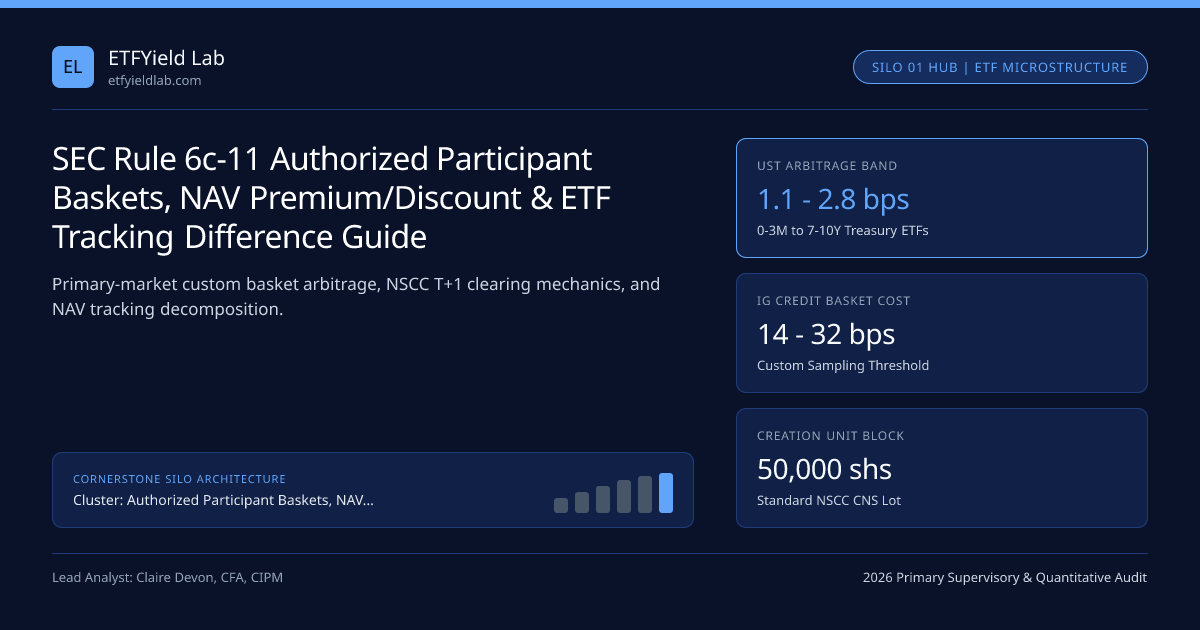
Under 17 CFR 270.6c-11, modern exchange traded fund liquidity rests on a continuous two-sided arbitrage loop linking lit secondary equity venues to over-the-counter underlying bond and equity portfolios. While retail and wealth-management orders interact inside penny-wide limit order books at Fidelity or Interactive Brokers, institutional price integrity is enforced by self-clearing Authorized Participants (APs) regulated by the U.S. Securities and Exchange Commission. Whenever secondary share prices drift beyond the marginal cost of assembling or liquidating the underlying basket, AP desks step in to mint or retire 50,000-share creation units at net asset value (NAV), collapsing persistent valuation gaps that routinely afflict closed-end income funds.
This Silo 01 cornerstone reference synthesizes the entire Authorized Participant & Tracking Hub research cluster. Below, we formalize no-arbitrage pricing boundaries, audit custom fixed income basket governance, separate structural tracking difference from volatile tracking error, and connect microstructure execution to our ETF expense ratio calculator and Bond yield & duration calculator.
Primary-Market Arbitrage Architecture Under SEC Rule 6c-11#
Prior to December 2019, every U.S. exchange traded fund operated under bespoke exemptive relief orders that created an uneven playing field: legacy sponsors enjoyed broad basket flexibility while newer entrants were locked into rigid pro-rata slice deliveries. SEC Rule 6c-11 eliminated that disparity for open-end ETFs by conditioning automatic exemptive relief on full daily website disclosure of portfolio holdings, standardized historical premium/discount tables, and median 30-day bid-ask spread reporting.
In fixed income markets, strict pro-rata replication is operationally impossible. An index such as the Bloomberg U.S. Aggregate Bond Index (Core Aggregate Bond ETFs) spans more than 13,000 individual CUSIPs, thousands of which do not trade on any given Tuesday. Our deep dive on SEC Rule 6c-11 custom basket policies in corporate bond ETFs demonstrates how portfolio managers negotiate smaller 150-to-400 bond creation baskets matched across key-rate bond duration, sector weight, and option-adjusted spread cells. Simultaneously, equity and multi-asset funds utilize custom redemption baskets to distribute appreciated tax lots in-kind—a statutory mechanism dissected in IRC Section 852(b)(6) heartbeat trades and ETF tax deferral. When sovereign markets prohibit foreign in-kind transfers, funds impose explicit cash-creation surcharges analyzed in cash-in-lieu creation fees in emerging market bond ETFs.
Quantitative Arbitrage Band & Tracking Decomposition Model#
An Authorized Participant does not arbitrage every 1-basis-point discrepancy between an ETF share print and published NAV. Primary creation or redemption occurs only when secondary mispricing exceeds total friction across underlying market impact, hedging cost, NSCC clearing, and sponsor basket fees:
- | (PETF - VBasket) / VBasket | <= (0.5 * SBasket) + CCreate + FFunding + H_Impact
- Annualized Tracking Difference (TD) & Tracking Error (TE):
- TDannual = RETF,net - R_Index
- = -ER + RSecLending - DragCash - TaxWithholding + AlphaSampling
- TEannual = sqrt(252) * StdDev( rETF,t - r_Index,t )
- Worked Institutional Example ($25,000,000 IG Corporate Bond ETF Creation):
- Underlying OTC Basket Half-Spread (0.5 * S_Basket) = 13.5 bps
- Fixed Sponsor Creation Fee ($1,500 on $25M block) = 0.6 bps
- Overnight T+1 SOFR Inventory Carry & Hedge Slippage = 2.4 bps
- Minimum Profitable AP Creation Premium Threshold = 16.5 bps ($41,250 gross edge)
Notice the sharp analytical distinction between tracking difference and tracking error. Over a 10-year compounding horizon—which allocators can project directly in the ETF expense ratio calculator—a -12 bps annual tracking difference compounds predictably into terminal wealth drag, whereas a 45 bps annualized tracking error reflects transient day-to-day valuation noise. We break down every Basis-Point contributor in tracking difference vs tracking error decomposition and evaluate cell-matching variance in physical full replication vs stratified sampling in bond ETFs.
Three-Tier Liquidity, Evaluated Bond Pricing & iNAV Asynchrony#
On-screen average daily share volume (ADV) captures only the tip of an ETF's liquidity iceberg. As quantified in three-layer ETF liquidity across order books, RFQ desks, and AP units, approximately 68% of institutional fixed income ETF volume executes inside secondary matched pools or dealer Request-for-Quote (RFQ) platforms without triggering a single primary creation share. For $10M+ portfolio reallocations, traders compare lit-book algorithms against risk-transfer dealers in RFQ block desk execution vs VWAP algo routing, while avoiding the opening and closing microstructure traps detailed in closing auction imbalance and MOC order ETF slippage.
Apparent NAV dislocations frequently stem from asynchronous accounting clocks rather than broken arbitrage:
- Time-Zone iNAV Lag: When London or Tokyo bond markets close hours before the 16:00 ET New York bell, U.S.-listed international ETFs price live macro shocks while underlying NAV remains frozen—see iNAV staleness in international bond and equity ETFs.
- Credit Stress Price Discovery: During corporate sell-offs, Investment-Grade Corporate Bond ETFs and High-Yield Corporate Bond ETFs print live executable clearing prices while evaluated bond matrix vendors lag by 24 to 48 hours, as proven in high-yield bond ETF NAV discounts during credit stress.
- Odd-Lot Municipal Marks & MBS Rolls: Retail muni odd-lot haircuts distort tax-exempt marks in municipal bond ETF odd-lot evaluated pricing, while To-Be-Announced forward settlements create monthly roll slippage examined in Agency MBS TBA roll settlement and ETF basket tracking.
Clearing Settlement, Balance Sheet Caps & Cross-Border Wrappers#
Since the May 2024 transition to T+1 equities and ETF settlement under SEC Rule 15c6-1(a), AP desks funding T+2 international underlying baskets face compressed FX and collateral windows, which we model in DTCC/NSCC T+1 settlement and AP collateral funding costs. At calendar quarter-ends, G-SIB dealer Supplementary Leverage Ratio (SLR) surcharges temporarily ration balance sheet capacity for primary market-making, widening fixed income premium/discount bands as documented in AP balance sheet SLR constraints at quarter-end.
| Execution & Custody Channel | Primary Supervisory Register | Secondary ETF Access & Routing | Custody / Clearing Safeguard | Microstructure Use Case |
|---|---|---|---|---|
| Interactive Brokers | FCA (License 208159) & ASIC (453554) | Direct SmartRouting, Algo VWAP/TWAP, UCITS & US ETFs | Segregated omnibus + statutory protection | Institutional & active multi-currency bond ETF execution |
| Fidelity | FINRA (CRD 288590) & SIPC | National NBBO price improvement, $0 US ETF commission | $500,000 SIPC net equity ($250k cash cap) | Core U.S. Treasury ladder & tax-lot harvesting sleeves |
| Charles Schwab | SFC (CE ADV256) & US broker-dealer | Listed limit/market orders, automated DRIP reinvestment | Segregated DTC street-name custody | Long-horizon fixed income & dividend ETF compounding |
| Fidelity International | UK Register (Ref 122169) & ESMA | LSE / Xetra / Euronext physical & swap UCITS share classes | UCITS V independent depositary safekeeping | European GBP/EUR hedged fixed income share classes |
| E*TRADE | FINRA (CRD 29106) | NBBO equity/ETF routing & odd-lot Treasury comparison | SIPC member brokerage custody | Retail T-Bill ETF vs direct auction ladder benchmarking |
Custody Architecture, European UCITS Swaps & Lifecycle Wind-Downs#
Cross-border and retail custody mechanics introduce four additional tracking vectors covered in our specialized Silo 01 briefs. European allocators evaluating swap-backed replication under ESMA counterparty limits should consult synthetic unfunded vs funded total return swap UCITS ETFs alongside UCITS currency-hedged share class forward roll costs. Inflation-linked allocators tracking iShares 0-3 Month Treasury Bond ETF (SGOV) against real-yield benchmarks can audit CPI accrual timing in TIPS CPI index ratio lag and ETF NAV drift. Finally, retail investors holding partial shares or sub-scale funds should review fractional ETF share omnibus internalization and SIPC custody and our forensic checklist on ETF closure, liquidation, and delisting NAV wind-down costs alongside our institutional compliance benchmarks and license verification portal.
Frequently asked questions
How does SEC Rule 6c-11 regulate custom creation and redemption baskets?
Adopted under Investment Company Act Release No. 33845, 17 CFR 270.6c-11 allows ETFs to accept or deliver non-pro-rata custom baskets only if the board adopts written policies governing basket construction, names a compliance officer to review best-interest determinations, and publishes daily portfolio holdings before market open.
Why do corporate bond ETFs trade at wider NAV premiums than Treasury ETFs?
On-the-run US Treasury bills and notes trade with sub-1-bp dealer spreads, keeping SGOV and IEF arbitrage bands near 1 to 3 bps. Investment-grade and high-yield corporate bonds trade over-the-counter with 15 to 65 bps bid-ask spreads, widening the AP arbitrage band before primary creation becomes profitable.
What separates ETF tracking difference from annualized tracking error?
Tracking difference is the arithmetic or geometric gap between an ETF total return and its benchmark index over a defined horizon, driven systematically by the expense ratio, securities lending offset, and withholding tax. Tracking error is the annualized standard deviation of periodic return differences.
Can retail investors submit creation units directly to an ETF sponsor?
No. Only self-clearing broker-dealers or prime-clearing institutions that execute an Authorized Participant Agreement with the fund distributor may create or redeem 25,000-to-100,000-share blocks through DTCC National Securities Clearing Corporation Continuous Net Settlement.
Publication record
- Published
- November 14, 2026
- Updated
- November 14, 2026
- Author
- Claire Devon, CFA, CIPM
- Review
- Review not recorded
- Automated fact check
- Passed in the stored pipeline record
- Source URLs
- 4 recorded
AI assistance recorded: anthropic/claude-opus-4.6. This field does not establish human review or source verification.
Academic & Institutional Attribution
Cite This Research & Embed Live Data Card
Standard academic & institutional research paper citation format.
Claire Devon, CFA, CIPM. (2026, November 14). SEC Rule 6c-11 Authorized Participant Baskets, NAV Premium/Discount & ETF Tracking Difference Guide. ETFYield Lab. https://etfyieldlab.com/yield-guides/sec-rule-6c-11-ap-custom-baskets-nav-tracking-guideRelated ETF Creation Redemption Tracking & Institutional Briefings
Explore ETF Creation Redemption Tracking Hub (20) →ETF Creation Redemption Tracking
SEC Rule 6c-11 Custom Basket Policies in Corporate Bond ETFs: CCO Governance & Sampling AlphaETF Creation Redemption Tracking
IRC Section 852(b)(6) Heartbeat Trades & In-Kind ETF Redemptions: Capital Gains Deferral MathETF Creation Redemption Tracking
Cash-in-Lieu Creation Fees & Slippage in Emerging Market Bond ETFs: AP Transaction Cost AuditETF Creation Redemption Tracking
iNAV Staleness in International Bond & Equity ETFs: Time-Zone Arbitrage & Fair-Value Price DiscoveryETF Creation Redemption Tracking
ETF Tracking Difference vs Tracking Error: Institutional Return Attribution & Fee Offset MathETF Creation Redemption Tracking
Three-Layer ETF Liquidity Waterfall: Lit Order Books, Dealer RFQ Inventory & AP Creation UnitsETF Creation Redemption Tracking
High-Yield Bond ETF NAV Discounts During Credit Stress: Live Price Discovery vs Stale Matrix MarksETF Creation Redemption Tracking
Municipal Bond ETF Odd-Lot Evaluated Pricing & MSRB EMMA NAV Spreads: Tax-Exempt ArbitrageSEC Yield Distribution Tax Drag
30-Day SEC Yield vs Distribution Rate, Return of Capital & After-Tax ETF Yield Drag GuideTreasury Bill Bond Ladder Etfs
T-Bill Ultrashort ETFs, Target-Maturity Bullet Ladders & Roll-Down Yield Engineering GuideCovered Call Buffer Option Etfs
Covered-Call Overlay ETFs, Defined-Outcome Buffer Caps & Upside Capture Master GuideDividend Growth Credit Income Etfs
Dividend Growth Screens, Preferred/Fallen-Angel Credit ETFs & Securities Lending Master Guide
ETFYield Lab Data, Benchmarks & Contributor Records
CC BY 4.0 Open Data
Open Institutional Datasets (CSV / JSON) →
Download desk-compiled quantitative series & schemas.
2026 Reference Matrix
2026 Institutional Benchmarks & Thresholds →
Statutory capital, clearing, margin & rate conventions.
Editorial Records
Authors & Review Records →
View named contributors where those records are available.
Complete Index
Master Research & Dossier Archive →
Browse all published briefings by topic pillar & date.