
ETF Creation Redemption Tracking
ETF Closure, Board Liquidation & Delisting Audit: Avoiding NAV Wind-Down & Tax Traps
Over 200 sub-scale ETFs under $50M AUM liquidate annually—halting Authorized Participant creations ahead of delisting, widening final-week bid-ask spreads 5x, and forcing involuntary taxable cash distributions.
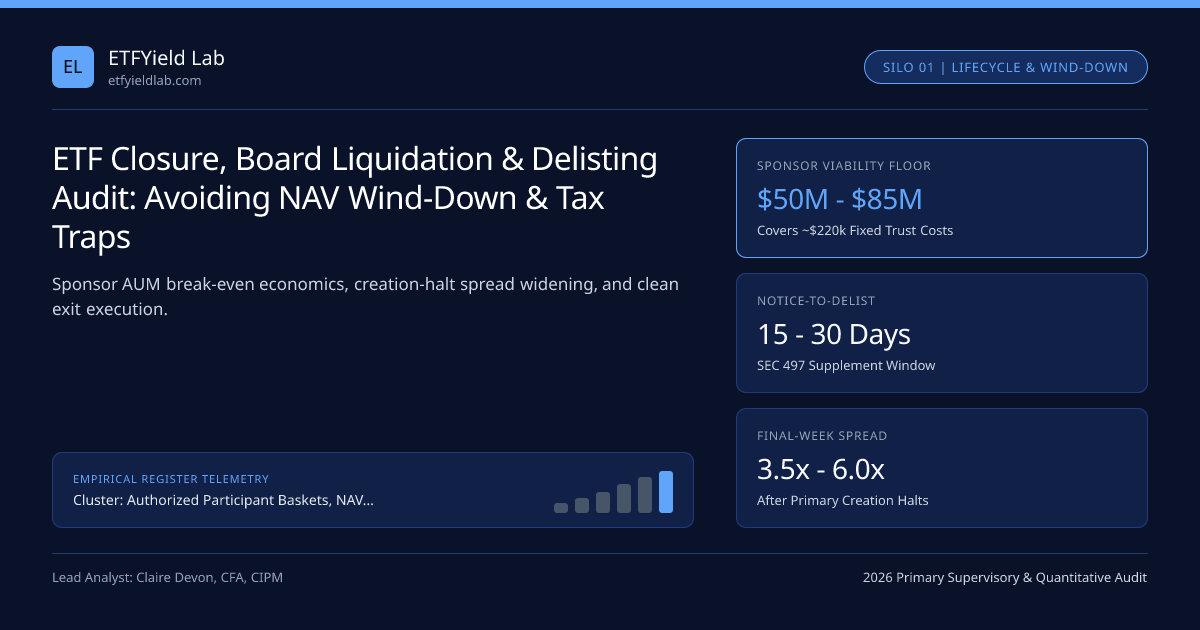
Every year, between 180 and 260 U.S.-listed exchange traded funds file SEC Rule 497 Prospectus Supplements announcing board-approved liquidation and exchange delisting. While shareholders never forfeit principal to sponsor insolvency—underlying assets remain ring-fenced inside an independent bank custodian and customer brokerage accounts carry SIPC protection—mishandling an ETF wind-down inflicts three preventable penalties: 5x wider final-week secondary bid-ask spreads, a 5-to-10-day frozen cash settlement gap, and forced taxable capital-gain realization that bypasses IRC Section 852(b)(6) tax deferral.
Concluding our 20-part Authorized Participant & Tracking Hub and SEC Rule 6c-11 AP Custom Baskets Guide, this forensic checklist separates sub-scale closure casualties from planned iShares iBonds & Invesco BulletShares Target-Maturity Bond Ladders maturities.
Sponsor Break-Even Economics & The 30-Day Wind-Down Timeline#
Running a standalone 1940 Act ETF series incurs $180,000 to $260,000 in annual fixed expenses: NYSE Arca/Nasdaq/Cboe listing fees, independent Big-Four audit, fund legal counsel, custodian accounting, NSCC basket administration, and benchmark index licensing. For a low-cost bond ETF charging 0.15%, $30 million AUM generates just $45,000 in gross revenue—forcing the sponsor to subsidize $175,000/yr out of pocket until the board votes to liquidate:
Sponsor Viability & Wind-Down Friction Equation#
Allocators screening newer ETFs can compute the exact Minimum Break-Even AUM required for a fund to sustain itself without indefinite sponsor fee subsidies, alongside the opportunity cost of getting trapped in the post-delisting cash freeze:
- AUMBreakeven = FixedAnnualTrustOverhead / ( ERNetRetained + SecLendingSponsor_Share )
- Shareholder Cost of Holding Through Delisting vs Early Limit-Order Exit:
- CostHoldtoLiquidation = PortfolioLiquidationSlippagebps
- + [ YOpportunityAnnual * (DaysFrozenPost_Delist / 365) ]
- + UnplannedCapGainDistTaxDrag
- Worked Sub-Scale Bond ETF Closure ($200,000 Position, 4.30% Alternative SGOV Yield):
- Fixed Trust Overhead = $210,000/yr | Headline ER = 0.25% -> Break-Even AUM = $84,000,000 (Fund stuck at $19M)
- Path A (Limit-Order Exit on Day 4 Post-Announcement): Pays 4.5 bps half-spread; reinvests T+1 into SGOV
- Path B (Ignores Notice; Held Through 7-Day Delisting Freeze + OTC Cash Liquidation):
- Portfolio Wind-Down Cash Slippage = 14.0 bps | 7-Day Zero-Yield Frozen Gap = 8.2 bps -> 22.2 bps Drag!
Notice how holding passively into liquidation costs nearly 5x more (22.2 bps vs 4.5 bps) than exiting cleanly via a limit order in Week 1 and rotating T+1 into iShares 0-3 Month Treasury Bond ETF (SGOV) or SPDR Bloomberg 1-3 Month T-Bill ETF (BIL), whose multi-year fee advantage you can verify in our ETF expense ratio calculator.
Secondary Spread Widening Across Wind-Down Stages#
Sub-Scale Closure vs Scheduled Target-Maturity Termination#
Never confuse an unscheduled sub-scale liquidation with a planned target-maturity rung termination:
| Lifecycle Event | Underlying Cause | Portfolio Transition Mechanics | Tax Impact in Taxable Account | Recommended Investor Action |
|---|---|---|---|---|
| Unscheduled Sub-Scale Closure (<$40M AUM) | Insufficient fee revenue to cover ~$210k trust overhead | Manager sells unmatured bonds in OTC market (10-25 bps slippage) | Forced Form 1099-B sale + potential Form 1099-DIV gain | Sell via limit order at Fidelity / IB within 10 days of SEC 497 notice |
| Scheduled Target-Maturity Exit (IBOND-TARGET-MAT) | Engineered maturity year (e.g., Dec 15, 2026) | Underlying corporate/muni bonds mature naturally at 100.00 par into T-Bills | Clean par redemption (Basis ~= Par if bought near par; check T-Bill tax tool) | Hold to December 15 par payout and roll proceeds to outer 10Y rung |
| ETF-to-ETF Tax-Free Merger (IRC Sec 368(a)) | Sponsor consolidates overlapping legacy lineups | In-kind asset transfer into surviving flagship ETF | Tax-free reorganization (cost basis carries over at Schwab / E*TRADE) | Verify surviving ETF expense ratio & index fit (SEC Rule 6c-11) |
| Mutual Fund -> ETF Conversion | Tax-efficiency upgrade by active/fixed-income manager | Direct in-kind conversion without cash sale | Tax-free carry-over (liquidate fractional stubs only; see fractional shares) | Retain upgraded ETF shares; audit secondary spread tier |
Pre-Investment Viability Gate#
Before allocating long-term taxable capital to any ETF launched within the last 36 months, check three survivability thresholds: AUM >= $75 million (or backed by a multi-trillion-dollar core sponsor committed to suite completeness), >= 4 active Authorized Participants on Form N-CEN, and contractual—rather than temporary 12-month voluntary—expense waivers.
Frequently asked questions
Do you lose all your money when an ETF closes and delists?
No! Unlike an operating company bankruptcy, an ETF is a segregated 1940 Act investment trust holding underlying bonds or equities at an independent custodian. Even if you hold through final liquidation, you receive cash equal to your pro-rata share of the liquidated portfolio NAV.
Should you sell a closing ETF on the exchange or wait for the final cash liquidation payout?
Sell via a patient limit order during the first 5 to 10 business days after the closure press release—while Authorized Participants are still actively redeeming units and spreads remain reasonable. Waiting triggers a 4-to-10-day cash lockup between delisting and payout plus potential portfolio wind-down slippage.
How does a scheduled target-maturity bond ETF maturity differ from an unexpected ETF closure?
Target-maturity ETFs (such as December 2026 iBonds or BulletShares) are engineered from inception to hold bonds maturing in that specific year, smoothly transitioning into Treasury bills by autumn and distributing par cash on Dec 15 with minimal market impact.
What are the early warning signs that an ETF faces elevated closure risk?
Three quantitative red flags signal >25% annual closure probability: (1) AUM stagnant below $35 million after 24-36 months of trading, (2) sponsor expiration of voluntary fee waivers, and (3) thematic/niche parent issuer shutting down sister funds.
Publication record
- Published
- November 14, 2026
- Updated
- November 15, 2026
- Author
- Claire Devon, CFA, CIPM
- Review
- Review not recorded
- Automated fact check
- Passed in the stored pipeline record
- Source URLs
- 4 recorded
AI assistance recorded: anthropic/claude-opus-4.6. This field does not establish human review or source verification.
Academic & Institutional Attribution
Cite This Research & Embed Live Data Card
Standard academic & institutional research paper citation format.
Claire Devon, CFA, CIPM. (2026, November 15). ETF Closure, Board Liquidation & Delisting Audit: Avoiding NAV Wind-Down & Tax Traps. ETFYield Lab. https://etfyieldlab.com/yield-guides/etf-closure-liquidation-delisting-nav-wind-down-auditRelated ETF Creation Redemption Tracking & Institutional Briefings
Explore ETF Creation Redemption Tracking Hub (20) →ETF Creation Redemption Tracking
SEC Rule 6c-11 Authorized Participant Baskets, NAV Premium/Discount & ETF Tracking Difference GuideETF Creation Redemption Tracking
SEC Rule 6c-11 Custom Basket Policies in Corporate Bond ETFs: CCO Governance & Sampling AlphaETF Creation Redemption Tracking
IRC Section 852(b)(6) Heartbeat Trades & In-Kind ETF Redemptions: Capital Gains Deferral MathETF Creation Redemption Tracking
Cash-in-Lieu Creation Fees & Slippage in Emerging Market Bond ETFs: AP Transaction Cost AuditETF Creation Redemption Tracking
iNAV Staleness in International Bond & Equity ETFs: Time-Zone Arbitrage & Fair-Value Price DiscoveryETF Creation Redemption Tracking
ETF Tracking Difference vs Tracking Error: Institutional Return Attribution & Fee Offset MathETF Creation Redemption Tracking
Three-Layer ETF Liquidity Waterfall: Lit Order Books, Dealer RFQ Inventory & AP Creation UnitsETF Creation Redemption Tracking
High-Yield Bond ETF NAV Discounts During Credit Stress: Live Price Discovery vs Stale Matrix MarksTreasury Bill Bond Ladder Etfs
SGOV vs BIL 0-3 Month U.S. Treasury Bill ETF Audit: Fee Drag, Penny Spreads & Roll MechanicsTreasury Bill Bond Ladder Etfs
0-3 Month T-Bill ETFs vs SEC Rule 2a-7 Treasury Money Market Funds: Yield, Fees & Liquidity GatesTreasury Bill Bond Ladder Etfs
Treasury Floating Rate Note ETFs (USFR & TFLO): Weekly 13-Week Auction Resets & Spread MathTreasury Bill Bond Ladder Etfs
Target-Maturity Bond ETFs (iShares iBonds & Invesco BulletShares): Building Defined-Year Corporate Ladders
ETFYield Lab Data, Benchmarks & Contributor Records
CC BY 4.0 Open Data
Open Institutional Datasets (CSV / JSON) →
Download desk-compiled quantitative series & schemas.
2026 Reference Matrix
2026 Institutional Benchmarks & Thresholds →
Statutory capital, clearing, margin & rate conventions.
Editorial Records
Authors & Review Records →
View named contributors where those records are available.
Complete Index
Master Research & Dossier Archive →
Browse all published briefings by topic pillar & date.