
ETF Creation Redemption Tracking
IRC Section 852(b)(6) Heartbeat Trades & In-Kind ETF Redemptions: Capital Gains Deferral Math
Internal Revenue Code Section 852(b)(6) exempts regulated investment companies from recognizing gain on in-kind redemptions, enabling ETF heartbeat trades to defer 98%+ of annual capital gains distributions.
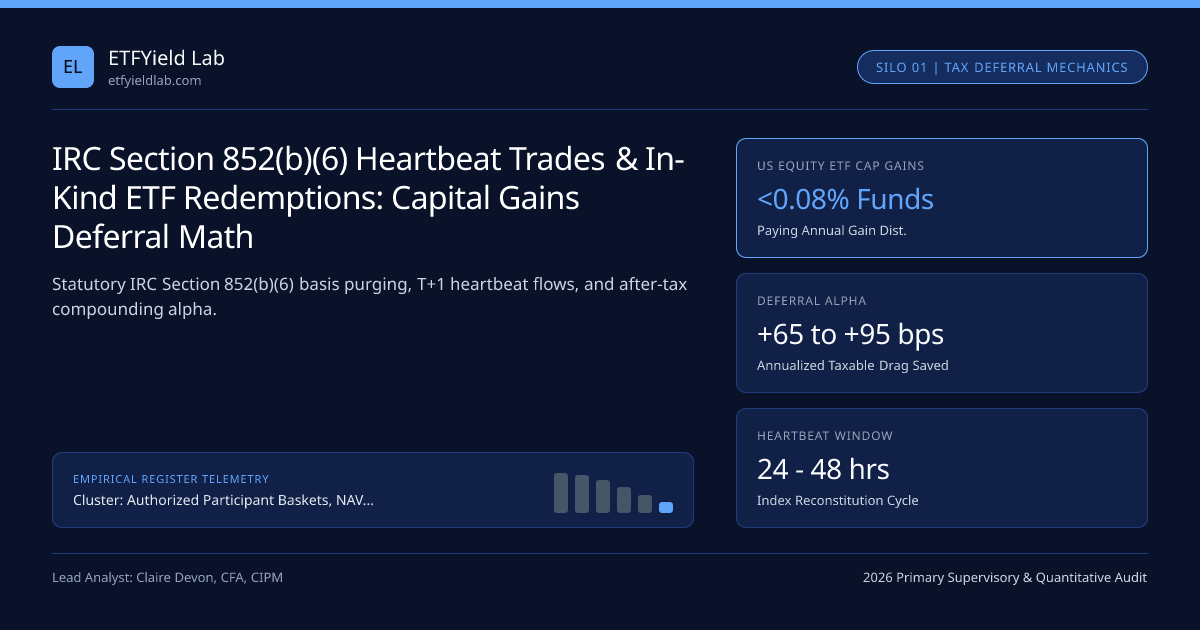
Enacted in 1969 as 26 U.S.C. Section 852(b)(6), a two-sentence provision of the Internal Revenue Code explains why U.S. physical exchange traded funds have captured trillions in taxable wealth away from traditional open-end mutual funds. Under Section 852(b)(6), a Regulated Investment Company (RIC) does not recognize gain upon the distribution of appreciated property in-kind to a redeeming shareholder on the demand of that shareholder. Combined with SEC Rule 6c-11 custom basket policies, this statute empowers ETF portfolio managers to hand their lowest-cost-basis securities to departing Authorized Participants, leaving continuing taxable investors with zero annual capital gains distributions.
As part of our Authorized Participant & Tracking Hub and SEC Rule 6c-11 AP Custom Baskets Guide, this analysis dissects the mechanics of institutional "heartbeat" trades, calculates multi-year deferral compounding, and identifies the exact fixed income exceptions where Section 852(b)(6) cannot shield distributions.
Anatomy of an Index Reconstitution Heartbeat Trade#
Whenever an equity or factor index deletes a constituent that has tripled over five years, a conventional mutual fund must sell that position for cash, realize the embedded capital gain, and distribute the taxable profit to all shareholders on Form 1099-DIV by December—even to investors who bought the fund last month. Physical ETFs execute a four-step heartbeat cycle instead:
On volume charts, a heartbeat trade looks unmistakable: a sudden $200 million creation spike on Thursday followed by an almost identical $200 million redemption outflow on Friday or Monday. Crucially, the AP is not acting out of charity; the AP earns a tight secondary-to-primary arbitrage spread on the creation-redemption pair while remaining completely tax-indifferent because securities dealers mark all inventory to market daily under IRC Section 475(a).
Quantifying Pre-Tax Compounding vs Mutual Fund Tax Drag#
Deferring capital gains taxes is mathematically equivalent to receiving a 0%-interest Treasury loan on the deferred tax liability for the entire holding period. Investors projecting multi-year distributions in our Dividend reinvestment calculator and ETF expense ratio calculator can verify how annual tax leakage dwarfs minor expense ratio differences:
- Mutual Fund (Annual Gain Turnover Realization greal = 4.5%, Tax tcg = 23.8%):
- RMF,aftertax = Rgross - (greal * tcg) - ERMF
- VMF(N) = P0 * (1 + RMF,aftertax)^N [plus residual basis adjustment]
- Physical ETF (0% Interim Capital Gain Distribution via IRC 852(b)(6)):
- VETF,preliq = P0 * (1 + Rgross - ER_ETF)^N
- VETF,net(N) = VETF,preliq - tcg * (VETF,preliq - P_0)
- Worked 15-Year Benchmark (8.00% Gross Return, 0.06% ETF ER vs 0.15% Mutual Fund ER):
- ETF Net Liquidated Value at Year 15 = $1,284,910 (after paying $286,430 exit tax)
- Tax-Dragging Fund Value at Year 15 = $1,142,380
- Compounded Section 852(b)(6) Deferral Edge = +$142,530 (+76 bps/yr annualized wealth pickup)
If the investor holds the ETF until death under current U.S. estate rules (IRC Section 1014 step-up in basis) or donates appreciated shares to a donor-advised charity, even the terminal $286,430 exit tax vanishes completely. This same tax-deferral logic motivates option-based Treasury alternatives such as Alpha Architect 1-3 Month Box ETF (BOXX), which adapts custom in-kind option settlement to short-term risk-free carry.
Where In-Kind Purging Breaks Down: Fixed Income & Cash Markets#
Allocators must never assume Section 852(b)(6) makes every ETF 100% immune to capital gains distributions. Four structural exceptions trigger taxable gains inside bond and international wrappers:
Empirical Capital-Gains Distribution Profile Across Fund Wrappers#
- Restricted Cash-Only Sovereigns: Markets requiring local onshore custody—explored in cash-in-lieu creation fees in emerging market bond ETFs—force cash redemptions when investors exit, triggering portfolio-level gain realization.
- Corporate Bond Cash Tenders & Maturities: When rates plunge after a credit sell-off, discounted bonds inside Core Aggregate Bond ETFs or Investment-Grade Corporate Bond ETFs mature at 100 par in cash or get retired via issuer tender offers.
- Currency-Hedged Forward Rolls: Monthly FX forward contracts settle in cash, generating realized gains when the U.S. dollar rallies sharply.
| Fund Wrapper / Strategy | Primary Creation Mechanism | Section 852(b)(6) Shield | Typical Annual Cap-Gain Drag | Optimal Account Placement |
|---|---|---|---|---|
| Physical U.S. Equity ETF | In-kind custom stock basket | Full (98%+ effective) | 0.00% - 0.02% | Taxable brokerage (Fidelity, Schwab) |
| U.S. Treasury / IG Bond ETF | In-kind custom CUSIP sample | Partial (cash maturities remain) | 0.00% - 0.12% | Taxable (T-Bills via T-Bill tax calculator) or IRA |
| Restricted EM Local Debt ETF | Cash-in-lieu creation/redemption | Minimal on restricted lines | 0.15% - 0.65% | Tax-deferred IRA / 401(k) |
| Currency-Hedged Bond ETF | In-kind bonds + cash FX forwards | Unshielded on FX forward leg | Variable (USD cycle dependent) | Institutional hedged or tax-sheltered sleeve |
Auditing Tax Efficiency Before Allocating Taxable Capital#
Tax-aware wealth managers executing at Interactive Brokers or E*TRADE under SIPC custody should inspect Item 13 ("Financial Highlights") of an ETF's annual Form N-CSR report. Specifically, check the fund's Accumulated Net Realized Loss Carryforwards: an ETF carrying substantial indefinite capital loss carryforwards from prior tax-loss-harvested bond rolls enjoys a secondary buffer that absorbs cash tender gains even before deploying a single heartbeat redemption.
Frequently asked questions
Are ETF heartbeat trades legal under current IRS and SEC regulations?
Yes. In-kind redemptions of appreciated securities are explicitly governed by Internal Revenue Code Section 852(b)(6), enacted in the Tax Reform Act of 1969, while non-pro-rata tax-lot selection inside custom redemption baskets is permitted under SEC Rule 6c-11(c)(3) subject to written compliance policies.
Why do bond ETFs occasionally pay capital gains despite Section 852(b)(6)?
Fixed income ETFs hold bonds that mature at par in cash, get called by corporate issuers for cash, or settle via cash-settled futures and FX forwards. Cash redemptions and matured principal above amortized cost cannot be purged via in-kind share delivery.
Does an Authorized Participant pay extra tax when receiving low-basis stock from an ETF?
No. Under mark-to-market dealer accounting (IRC Section 475), an Authorized Participant records incoming securities at fair market value on the redemption settlement date. The ETF historical low tax basis disappears without penalizing the AP.
How much after-tax alpha does capital gains deferral add over 15 years?
Avoiding a 4% annual capital gain distribution taxed at 23.8% (20% federal long-term rate plus 3.8% NIIT) preserves roughly 95 bps of invested capital per year, increasing 15-year after-tax wealth by 11% to 16% even after paying deferred exit tax at liquidation.
Publication record
- Published
- November 14, 2026
- Updated
- November 15, 2026
- Author
- Claire Devon, CFA, CIPM
- Review
- Review not recorded
- Automated fact check
- Passed in the stored pipeline record
- Source URLs
- 4 recorded
AI assistance recorded: anthropic/claude-opus-4.6. This field does not establish human review or source verification.
Academic & Institutional Attribution
Cite This Research & Embed Live Data Card
Standard academic & institutional research paper citation format.
Claire Devon, CFA, CIPM. (2026, November 15). IRC Section 852(b)(6) Heartbeat Trades & In-Kind ETF Redemptions: Capital Gains Deferral Math. ETFYield Lab. https://etfyieldlab.com/yield-guides/irc-section-852-b-6-heartbeat-trades-etf-tax-deferralRegulatory Directory Cross-Reference
Referenced Institutions & Regulatory Registries
Mentioned Regulated Institutions
Related ETF Creation Redemption Tracking & Institutional Briefings
Explore ETF Creation Redemption Tracking Hub (20) →ETF Creation Redemption Tracking
SEC Rule 6c-11 Authorized Participant Baskets, NAV Premium/Discount & ETF Tracking Difference GuideETF Creation Redemption Tracking
Cash-in-Lieu Creation Fees & Slippage in Emerging Market Bond ETFs: AP Transaction Cost AuditETF Creation Redemption Tracking
iNAV Staleness in International Bond & Equity ETFs: Time-Zone Arbitrage & Fair-Value Price DiscoveryETF Creation Redemption Tracking
ETF Tracking Difference vs Tracking Error: Institutional Return Attribution & Fee Offset MathETF Creation Redemption Tracking
Three-Layer ETF Liquidity Waterfall: Lit Order Books, Dealer RFQ Inventory & AP Creation UnitsETF Creation Redemption Tracking
High-Yield Bond ETF NAV Discounts During Credit Stress: Live Price Discovery vs Stale Matrix MarksETF Creation Redemption Tracking
Municipal Bond ETF Odd-Lot Evaluated Pricing & MSRB EMMA NAV Spreads: Tax-Exempt ArbitrageETF Creation Redemption Tracking
DTCC/NSCC T+1 Settlement & ETF Authorized Participant Collateral Funding CostsSEC Yield Distribution Tax Drag
Destructive vs Constructive Return of Capital (ROC): SEC Rule 19a-1 Notices & Form 1099-DIV Box 3SEC Yield Distribution Tax Drag
IRC Section 1256 60/40 Tax Treatment in Index Option ETFs: SPX, NDX & RUT After-Tax Yield MathSEC Yield Distribution Tax Drag
Synthetic Box-Spread ETF (BOXX) vs Direct T-Bills: IRC Section 1258 Conversion & State Tax MathSEC Yield Distribution Tax Drag
Irish-Domiciled UCITS ETFs: 15% vs 30% U.S. Dividend Treaty Withholding & Estate Tax Shield
ETFYield Lab Data, Benchmarks & Contributor Records
CC BY 4.0 Open Data
Open Institutional Datasets (CSV / JSON) →
Download desk-compiled quantitative series & schemas.
2026 Reference Matrix
2026 Institutional Benchmarks & Thresholds →
Statutory capital, clearing, margin & rate conventions.
Editorial Records
Authors & Review Records →
View named contributors where those records are available.
Complete Index
Master Research & Dossier Archive →
Browse all published briefings by topic pillar & date.