
Covered Call Buffer Option Etfs
Bank Autocallable Structured Notes vs OCC-Cleared Buffer ETFs: Credit Risk, Hidden Fees & Liquidity
Private wealth desks sell $120B+ annually in OTC bank Autocallable & Buffered Structured Notes embedding 1.5% to 3.25% hidden underwriting fees, Lehman-style unsecured bank credit exposure, & ordinary tax drags!
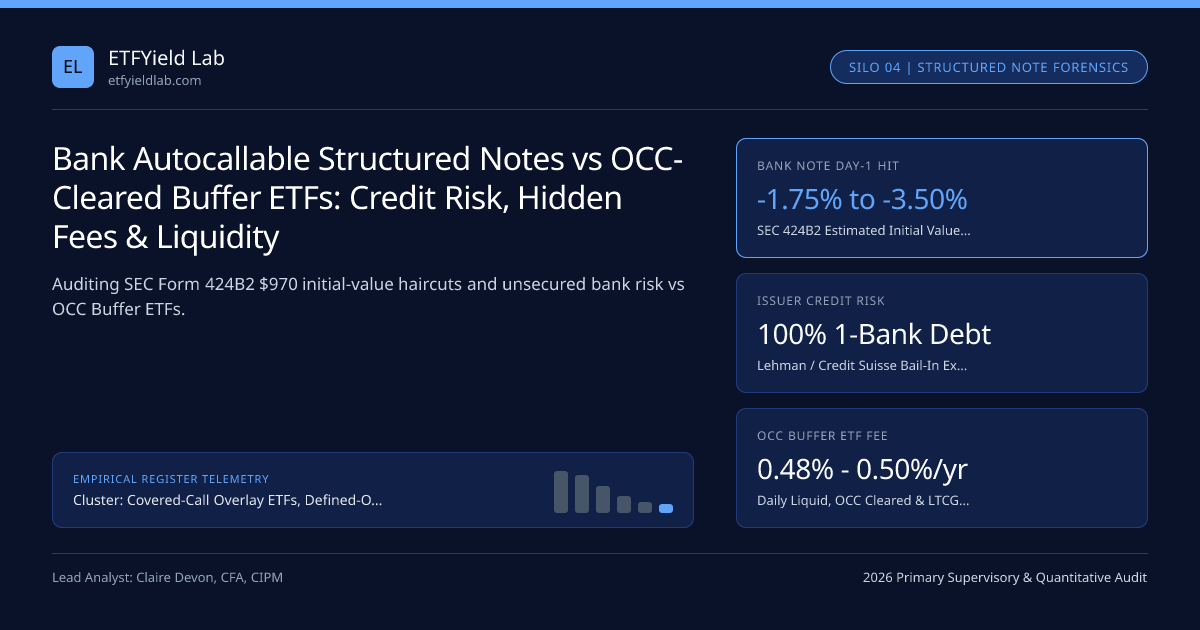
Why do private-bank wealth advisors pitch OTC Bank Autocallable & Buffered Structured Notes vastly harder than 0.50% ETFs? Follow the compensation trail on SEC Form 424B2: a $500,000 2-year bank structured note routinely pays a 2.00% to 3.00% upfront placement concession ($10,000 to $15,000 on Day 1!) baked invisibly into the option terms, while exposing your principal to 100% single-bank unsecured credit risk! Comparing OTC Bank Notes against OCC-Cleared Cboe FLEX Buffer ETFs exposes one of wealth management’s widest fiduciary gaps.
Inside our Covered-Call & Buffer ETF Hub and Option-Overlay Master Guide, read this fiduciary audit alongside our 4-leg Cboe FLEX clearing blueprint and 100% Max Buffer vs CD/Annuity comparison.
Head-to-Head Plumbing: OTC Bank Note (Form 424B2) vs OCC-Cleared Buffer ETF#
Trace what happens to your $250,000 across credit safety, Day-1 fair value, secondary liquidity, and tax deferral:
Quantitative Proof: "Worst-Of" Autocallable Correlation & Fee Haircut Math#
Private banks love selling "10.5% Contingent-Coupon Worst-Of Autocallables on SPX / Russell 2000 / EuroStoxx 50 with a 70% Knock-In Barrier." Why does that note pay 10.5%? Because you are short multi-index dispersion AND paying a 2.75% upfront fee!
- 1. Instant Day-1 Fee Haircut (SEC Form 424B2 Mandatory Disclosure):
- UpfrontDrag = ($1,000.00 - EstimatedInitialValue$972.50) / $1,000 = -2.75% Day-1 Loss!
- (If autocalled at Month 6 in a bull market -> Annualized Fee Drag = -5.50%/yr!)
- 2. "Worst-Of-3" Knock-In Barrier Breach Probability (Single Index P(Drop > 30%) = 9.0%, Corr = 0.65):
- P(Min(SPX, RTY, SX5E) < 70% Barrier) ~= 21.4% (2.38x HIGHER Crash Exposure Than SPX Alone!)
- AND if RTY finishes at -32% while SPX is +18%:
- You lose -32% of principal (+ forfeited dividends + bank credit spread widening)!
- 3. Clean Institutional Replacement ($250,000):
- Combine 50% FBUF / IVVM (0.48%-0.50% Buffer ETF) + 50% GPIX (0.29% Dynamic OTM)
- > 0.39% Blended Fee, ZERO single-bank credit risk, daily T+1 liquidity, LTCG tax control!
Audit the 10-year compounding loss of recurring 2.5% structured-note placement fees in our ETF expense ratio calculator, and verify risk-free sovereign collateral yields on SGOV and BOXX in our T-Bill vs duration ETF tax-equivalent yield comparator.
Comparing Structured Payoff Wrappers Side-by-Side#
Fiduciary Replacement Matrix Across Verified Custodians#
| Bank Structured Note Pitch | Clean 1940-Act ETF Replacement | Annualized Cost Saved | Custody & Regulatory Rail |
|---|---|---|---|
| "15% Buffered S&P 500 1-to-2Y Bank Note" | iShares IVVM (0.50%) or Fidelity FBUF (0.48%) | Saves +150–250 bps | Segregated custody at Fidelity / Schwab (SIPC) |
| "100% Principal-Protected Market-Linked Note" | iShares MAXJ (0.50%) or 82% BOXX + 18% VOO | Saves +175+ bps | LTCG deferral + OCC clearing at Interactive Brokers |
| "10% Contingent-Coupon Equity Autocallable" | 60% GPIX (0.29%) + 40% SGOV (0.09%) | Saves +230+ bps | Zero "Worst-Of" Russell 2000 trap (SEC Rule 18f-4)! |
| Existing Matured Structured Note Cash | Redeploy into transparent ETFs; never auto-roll into new 424B2 notes! | Stops recurring 2.5% hits | Model growth in Dividend reinvestment calc |
One-Question Fiduciary Litmus Test#
Next time a private-wealth advisor pitches a Bank Structured Note, ask one polite question: "What is the exact SEC Form 424B2 Estimated Initial Value per $1,000, and why should I take unsecured single-bank credit risk when OCC-cleared 0.48% FBUF or 0.50% IVVM trades at a 2-basis-point spread with perpetual tax deferral?"
Frequently asked questions
Does $500,000 SIPC brokerage insurance protect me if the bank that issued my Structured Note goes bankrupt?
NO! SIPC protects custody of your brokerage account if your BROKER fails—it NEVER insures the market or credit value of a bankrupt issuer’s bond or structured note! When Lehman Brothers filed Chapter 11 in 2008, investors holding "100% Principal-Protected Lehman Notes" suffered catastrophic unsecured-creditor losses!
Where can I see the hidden fee inside a private-bank Structured Note?
Look on the very bottom of Page 1 of the SEC Rule 424(b)(2) Final Pricing Supplement for the mandatory SEC disclosure line: "The estimated initial value of the notes as of the trade date is $971.40 per $1,000 principal amount." That $28.60 gap (2.86%!) is your instant Day-1 fee + dealer structuring margin!
What happens if I need to sell a Bank Structured Note before its 2-to-5-year maturity?
There is ZERO exchange listing! You are entirely at the mercy of the issuing bank’s internal secondary desk making a discretionary bid—typically quoting 150 to 300 bps below fair value (and widening or stepping back entirely during market panics!).
Why are Autocallable Structured Notes also tax-inefficient when called early?
When stocks rally in Month 6 or Month 9, an Autocallable Note gets automatically called ("autocalled") at par plus coupon—forcing an involuntary taxable cash event (often taxed as ordinary contingent interest or short-term gain) AND forcing you to reinvest right after fees!
Publication record
- Published
- November 13, 2026
- Updated
- November 14, 2026
- Author
- Claire Devon, CFA, CIPM
- Review
- Review not recorded
- Automated fact check
- Passed in the stored pipeline record
- Source URLs
- 4 recorded
AI assistance recorded: anthropic/claude-opus-4.6. This field does not establish human review or source verification.
Academic & Institutional Attribution
Cite This Research & Embed Live Data Card
Standard academic & institutional research paper citation format.
Claire Devon, CFA, CIPM. (2026, November 14). Bank Autocallable Structured Notes vs OCC-Cleared Buffer ETFs: Credit Risk, Hidden Fees & Liquidity. ETFYield Lab. https://etfyieldlab.com/yield-guides/bank-autocallable-structured-notes-vs-occ-flex-buffer-etfsRelated Covered Call Buffer Option Etfs & Institutional Briefings
Explore Covered Call Buffer Option Etfs Hub (20) →Covered Call Buffer Option Etfs
Covered-Call Overlay ETFs, Defined-Outcome Buffer Caps & Upside Capture Master GuideCovered Call Buffer Option Etfs
Gold & Commodity Covered-Call ETFs (GLDI, IAUI & SLVO): Positive Call Skew, ETN Risk & Inflation CapsCovered Call Buffer Option Etfs
Retirement Sequence-of-Returns Risk With Covered-Call ETFs: Why 8% Spend-Down Depletes Capped PortfoliosCovered Call Buffer Option Etfs
How SOFR Interest Rates & Volatility Skew Price Buffer ETF Upside Caps: Black-Scholes Budget MathCovered Call Buffer Option Etfs
The Hidden Dividend Forfeiture Inside Buffer ETFs: Price-Return Index Reference vs Total-Return S&P 500Covered Call Buffer Option Etfs
IRC Section 1092 Tax Straddles & Qualified Covered Calls (QCC) in Option ETFs: Holding-Period & QDI TrapsCovered Call Buffer Option Etfs
100% ATM Monthly Covered-Call ETFs (XYLD & QYLD): Upside Truncation & Secular NAV Decay MathCovered Call Buffer Option Etfs
OTM Dynamic Overwrite ETFs (JEPI, JEPQ & GPIX): Equity-Linked Notes (ELNs) vs Direct Index OptionsDividend Growth Credit Income Etfs
Taxable vs Roth/Traditional IRA DRIP Compounding Math: Tax-Lot Hygiene & Yield-on-Cost MythsDividend Growth Credit Income Etfs
Investment-Grade Corporate Bond ETFs (LQD, VCIT & VCSH): BBB Cliff Risk, OAS & Duration DriftDividend Growth Credit Income Etfs
High-Yield Corporate Bond ETFs (HYG, JNK & USHY): Default- & Recovery-Adjusted Net Credit CarryDividend Growth Credit Income Etfs
The BB/BBB Credit Crossover Anomaly: Duration-Times-Spread (DTS) Risk Parity & Sharpe Optimization
ETFYield Lab Data, Benchmarks & Contributor Records
CC BY 4.0 Open Data
Open Institutional Datasets (CSV / JSON) →
Download desk-compiled quantitative series & schemas.
2026 Reference Matrix
2026 Institutional Benchmarks & Thresholds →
Statutory capital, clearing, margin & rate conventions.
Editorial Records
Authors & Review Records →
View named contributors where those records are available.
Complete Index
Master Research & Dossier Archive →
Browse all published briefings by topic pillar & date.