
Covered Call Buffer Option Etfs
Cboe FLEX 4-Leg Defined-Outcome Buffer ETFs (10% & 15% Buffers): Option Payoff & Pricing Architecture
Defined-Outcome Buffer ETFs construct an exact institutional 4-leg European Cboe FLEX option portfolio—a zero-strike deep-ITM call, a long ATM/OTM protective put spread, and a short OTM call cap—absorbing the first 9%, 10%, 15%, or 20% of S&P 500 price losses over a 12-month outcome period.
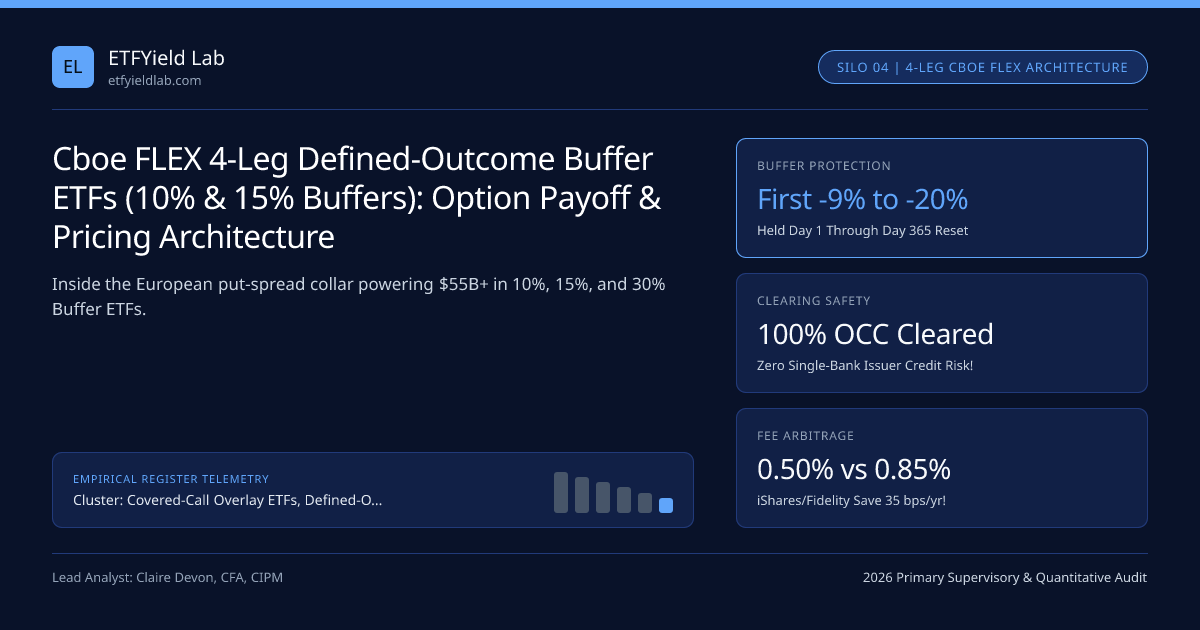
Before 2018, obtaining a contractual 15% S&P 500 downside buffer funded by an upside return cap required locking $250,000 inside an illiquid, opaque bank structured note carrying 2.00% embedded placement commissions and unsecured bank bankruptcy risk. Cboe FLEX (Flexible Exchange) Defined-Outcome Buffer ETFs democratized that institutional payoff inside liquid, daily-tradable, OCC-cleared 1940-Act ETF shares that defer capital gains across unlimited annual resets!
Within our Covered-Call & Buffer ETF Hub and Option-Overlay Master Guide, pair this foundational 4-leg blueprint with two mandatory companion audits: the mid-period entry cap-erosion trap and price-return index dividend forfeiture.
Inside the 4-Leg Cboe FLEX Replication Engine#
How does a 15% S&P 500 Buffer ETF (such as Innovator PJAN/PJUL at 0.79% ER, First Trust FJAN at 0.85% ER, or lower-fee BlackRock/iShares IVVM/IVVB at 0.50% ER) construct its Day-365 hockey-stick payoff without owning a single share of Apple or Microsoft? By combining four European-style Cboe FLEX options expiring on the exact same date:
Exact Day-365 Payoff Piecewise Equation vs Uncapped Barbell#
Let $R{ ext{SPXPrice}}$ denote the 365-day price return of the S&P 500 (excluding ~1.35% dividends!), $B = 0.15$ denote the 15% buffer, $C_{ ext{gross}}$ denote the auctioned gross cap, and $ ext{ER}$ denote the annual expense ratio:
- RBufferNet =
- | Cgross - ER if RSPXPrice >= Cgross (Capped Bull Market)
- | RSPXPrice - ER if 0 <= RSPXPrice < C_gross (Uncapped Moderate Gain)
- | 0.00% - ER if -B <= RSPXPrice < 0 (Buffered Zero-Loss Zone!)
- | (RSPXPrice + B) - ER if RSPXPrice < -B (Tail Crash Beyond Buffer)
- Worked Benchmark Comparison ($250,000 Pre-Retirement Sleeve: 15% Buffer @ 14.5% Gross Cap & 0.50% ER vs 70% VOO + 30% SGOV):
- 1. Severe Bear Crash (SPX Price = -25.0%, SPX Div = +1.4%, SGOV = +4.4%):
- 15% Buffer ETF (0.50% ER) = (-25.0% + 15.0%) - 0.50% = -10.50%
- 70% VOO + 30% SGOV (0.05% ER) = 0.70(-23.6%) + 0.30(+4.4%) = -15.20% -> Buffer WINS by +470 bps!
- 2. Moderate Down Year (SPX Price = -12.0%):
- 15% Buffer ETF = -0.50% vs 70/30 Barbell = -6.10% -> Buffer WINS by +560 bps!
- 3. Strong Bull Year (SPX Price = +24.0%, Total Return = +25.4%):
- 15% Buffer ETF = +14.00% Net Cap vs 70/30 Barbell = +19.10% -> Barbell WINS by +510 bps!
Compare 0.50% ER next-generation buffer ETFs against legacy 0.79%–0.85% ER series in our ETF expense ratio calculator, and check T-Bill barbell after-tax yields in our T-Bill vs duration ETF tax-equivalent yield comparator.
Comparing Buffer Depths & Fee Tiers Across Major Issuers#
Issuer & Account Selection Matrix Across Custodians#
| Protection Mandate | Optimal Buffer ETF Implementation | Net Fee | Custody & Pre-Trade Check |
|---|---|---|---|
| Lowest-Cost Core Buffer Exposure | iShares Large Cap Moderate/Deep Buffer (IVVM / IVVB) | 0.50% | Verify live Remaining Cap before limit order at Fidelity (SIPC) |
| Hands-Off 4-Quarter Laddered Buffer | Fidelity Dynamic Buffered (FBUF, 0.48%) or BUFR (0.95%) | 0.48% | Zero mid-period entry trap at Schwab |
| Exact Calendar-Month Liability Match | Innovator 12-Month Series (PJAN–PDEC / UJAN–UDEC) | 0.79% | Deepest monthly liquidity at Interactive Brokers |
| Low-Cost Uncapped DIY Rival | 70% VOO + 30% SGOV / BOXX | 0.05% | Regulated under SEC Rule 18f-4 & OCC clearing |
Mandatory Pre-Trade Rule#
Never click "Buy" on a single-month Buffer ETF ticker (PJUN, BOCT, IVVM) without first checking its Intraday Remaining Cap & Remaining Buffer—which brings us directly to Spoke 05!
Frequently asked questions
Do Defined-Outcome Buffer ETFs carry bank credit default risk like Lehman Brothers structured notes?
NO! Unlike OTC bank structured notes (which are unsecured debt obligations of a single issuing bank), Cboe FLEX options are centrally cleared and guaranteed by the AAA-rated Options Clearing Corporation (OCC) with daily mark-to-market margining under SEC Rule 18f-4!
Why does a 15% Buffer ETF drop ~-4% when the S&P 500 drops -8% SIX MONTHS into the outcome period?
Because Cboe FLEX options are European-style contracts whose exact 0%-loss buffer applies AT FINAL DAY-365 EXPIRATION! Mid-year, remaining time value and implied volatility mean your ETF has ~0.45-0.55 delta; only as Day 365 approaches does option theta pull NAV cleanly back up to your 0% buffered floor!
What happens at the end of the 12-month Outcome Period if I just keep holding the ETF?
You do NOT have to sell or pay capital gains taxes! On the annual reset afternoon, the ETF’s portfolio managers roll all four FLEX legs into a brand-new 365-day outcome period with a fresh 10% or 15% buffer and a newly auctioned upside cap!
What is the difference between a "Standard Buffer" (0% to -15%) and a "Deep Buffer" (-5% to -30%)?
A Standard 15% Buffer absorbs the FIRST 15% of index loss (0% down to -15%). A Deep Buffer (e.g., Innovator Ultra Series, -5% to -35%) acts like high-deductible catastrophe insurance: you eat the first -5% dip yourself, and the ETF absorbs everything from -5% down to -35%!
Publication record
- Published
- November 13, 2026
- Updated
- November 14, 2026
- Author
- Claire Devon, CFA, CIPM
- Review
- Review not recorded
- Automated fact check
- Passed in the stored pipeline record
- Source URLs
- 3 recorded
AI assistance recorded: anthropic/claude-opus-4.6. This field does not establish human review or source verification.
Academic & Institutional Attribution
Cite This Research & Embed Live Data Card
Standard academic & institutional research paper citation format.
Claire Devon, CFA, CIPM. (2026, November 14). Cboe FLEX 4-Leg Defined-Outcome Buffer ETFs (10% & 15% Buffers): Option Payoff & Pricing Architecture. ETFYield Lab. https://etfyieldlab.com/yield-guides/cboe-flex-defined-outcome-buffer-etfs-10-15-payoff-mathRelated Covered Call Buffer Option Etfs & Institutional Briefings
Explore Covered Call Buffer Option Etfs Hub (20) →Covered Call Buffer Option Etfs
Covered-Call Overlay ETFs, Defined-Outcome Buffer Caps & Upside Capture Master GuideCovered Call Buffer Option Etfs
Entering Defined-Outcome Buffer ETFs Mid-Period: Remaining Cap Compression & Unbuffered Zone MathCovered Call Buffer Option Etfs
Treasury & Corporate Bond Covered-Call ETFs (TLTW, LQDW & HYGW): Harvesting MOVE Rate Volatility SkewCovered Call Buffer Option Etfs
Cash-Secured Put-Write ETFs (PUTW) vs Covered-Call Buy-Write (XYLD): Put-Call Parity & T-Bill CarryCovered Call Buffer Option Etfs
Variance Risk Premium (IV Minus RV) in Option-Income ETFs: Regime Attribution Across VIX 12 to VIX 45Covered Call Buffer Option Etfs
Synthetic Single-Stock Covered-Call ETFs: Idiosyncratic Jump Risk, Swap Financing & Total-Return LagCovered Call Buffer Option Etfs
SEC Rule 18f-4 Derivatives Risk Management in Option ETFs: 200% Relative VaR & Stress DisclosuresCovered Call Buffer Option Etfs
Laddered 4-Quarter Buffer ETFs (BUFR & FBUF) vs Single-Outcome Series: Smoothing Reset Path RiskDividend Growth Credit Income Etfs
Preferred Stock ETFs (PFF, PGX & VRP): $25 Par Call Yield-to-Worst, Fixed-to-Floating & Bank RiskDividend Growth Credit Income Etfs
Fallen-Angel BB Corporate Bond ETFs (ANGL & FALN) vs Original-Issue Junk: Forced-Selling Alpha MathDividend Growth Credit Income Etfs
Senior Floating-Rate Bank Loan ETFs (BKLN & SRLN): T+7 Loan Settlement vs T+1 Rule 22e-4 LiquidityDividend Growth Credit Income Etfs
BDC ETFs (BIZD & PBDC): Payment-in-Kind (PIK) Income Quality, Non-Accruals & AFFE Fee Disclosure
ETFYield Lab Data, Benchmarks & Contributor Records
CC BY 4.0 Open Data
Open Institutional Datasets (CSV / JSON) →
Download desk-compiled quantitative series & schemas.
2026 Reference Matrix
2026 Institutional Benchmarks & Thresholds →
Statutory capital, clearing, margin & rate conventions.
Editorial Records
Authors & Review Records →
View named contributors where those records are available.
Complete Index
Master Research & Dossier Archive →
Browse all published briefings by topic pillar & date.