
Treasury Bill Bond Ladder Etfs
Constant-Maturity Roll-Down Return vs Held-to-Maturity Pull-to-Par: Yield Curve Math
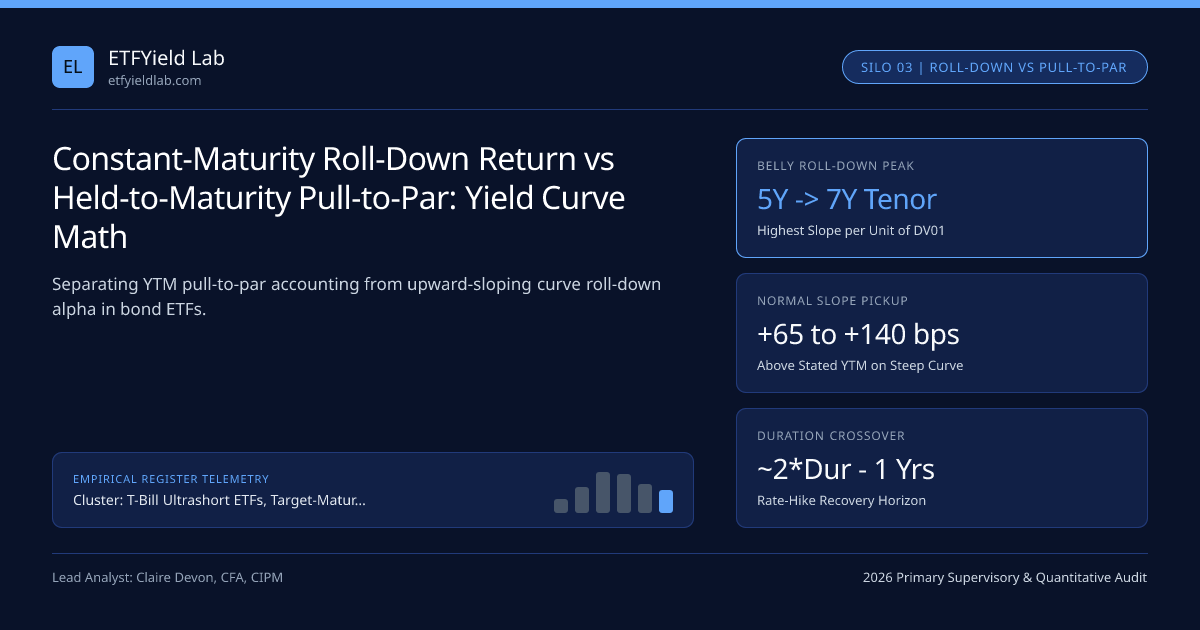
Holding bonds to maturity sacrifices one of fixed income strongest structural return engines: on a normally upward-sloping curve, constant-maturity ETFs sell seasoned bonds at lower shorter-tenor yields every month—capturing +65 to +145 bps of annual roll-down capital gain above stated YTM.
"Never buy a constant-maturity bond ETF like iShares 7-10 Year Treasury Bond ETF (IEF) or Core Aggregate Bond ETFs (AGG & BND) because ETFs never mature!" You hear that slogan every week on television—and on a normally upward-sloping yield curve, following it costs long-term portfolios 60 to 135 basis points of annualized compounding every single year! To build institutional-grade fixed income sleeves inside our T-Bill & Bond Ladder Hub and T-Bill & Bond Ladder Master Guide, allocators must separate the accounting identity of Pull-to-Par from the slope-harvesting alpha of Constant-Maturity Roll-Down.
Busting the "Pull-to-Par" Myth vs True Curve Roll-Down#
When you hold an individual bond or Target-Maturity iBonds/BulletShares ETF (IBOND-TARGET-MAT) to final maturity, its duration shrinks to zero—meaning it stops working on the steep part of the curve and spends its final two years earning low front-end yields! A constant-maturity ETF (IEF holding 7–10Y notes, or iShares 1-3 Year Treasury Bond ETF (SHY) holding 1–3Y notes) perpetually surfs the steepest segment of the yield curve:
And look at Metric #1 above—connecting right back to Silo 01 microstructure! If you tried to replicate constant-maturity roll-down manually with individual Treasury notes in a taxable account, selling your appreciated 7-year note every year would trigger taxable capital gains! Inside an ETF, appreciated 7-year notes exit via in-kind redemptions (IRC Section 852(b)(6)), deferring roll-down capital gains indefinitely!
Exact Mathematical Proof: Carry + Roll-Down Horizon Return#
Let $y(T)$ denote the par yield at maturity $T$, and $D(T - Delta t)$ denote the modified duration at the end of holding period $Delta t = 1 ext{ year}$:
- Rolling_Yield(T) = y(T) + D(T - 1) * [ y(T) - y(T - 1) ]
- _____________________________/
- Annualized Roll-Down Alpha!
- Martin Leibowitz Duration Crossover Theorem (Constant-Maturity Fund Under Instantaneous Hike +Delta_y):
- At Horizon H* ~= (2 * Dur_Mod) - 1 Years, Cumulative Return equals Initial YTM regardless of rate shock!
- Worked Upward-Sloping Curve Audit (2Y = 3.65%, 5Y = 4.05%, 7Y = 4.25%, 10Y = 4.45%):
- 1. 1-Year Roll on 7Y -> 6Y Note (y(7)=4.25%, y(6)=4.15%, End Dur = 5.25 yrs):
- Carry = 4.25% | Roll-Down = 5.25 * (+0.10%) = +0.525% -> Total Rolling Yield = 4.78% (+113 bps > 2Y!)
- 2. Inverted-Curve Counter-Example (2Y = 4.90%, 7Y = 4.25%, y(6) = 4.40% — UPWARD roll into higher yield!):
- Carry = 4.25% | Roll-Down = 5.25 * (-0.15%) = -0.788% -> Total Rolling Yield = 3.46% (Lagging cash!)
Run your live curve slope numbers in our Bond yield & duration calculator and check tax-adjusted breakevens in our T-Bill vs duration ETF tax-equivalent yield comparator alongside yield-curve steepening rotation rules.
Comparing Rolling Yield Across Upward vs Inverted Curve Regimes#
Decision Matrix: Defined-Maturity Ladder vs Constant-Maturity ETF#
| Portfolio Mandate | Optimal Wrapper Choice | Curve Regime Sensitivity | Verified Custody & Tool |
|---|---|---|---|
| Known Cash Liability (Tuition 2029, Home 2028) | Target-Maturity ETF (IBOND-TARGET-MAT) | Immune to rate hikes if held to Dec 15 | Fidelity / Schwab (SIPC) |
| 60/40 Perpetual Rebalance / Endowment | Constant-Maturity Belly (IEF / VGIT) | Maximizes roll-down + crash rebalancing alpha | Interactive Brokers / SEC |
| Conservative 2-4 Year Reserve | 1-3Y Short Treasury (SHY / VGSH) | Heals +100 bps hike inside ~2.8 years | Bond yield & duration calculator |
Deeply Inverted Yield Curve (2Y > 10Y + 50 bps) | Overweight SGOV/USFR + Short Ladder | Avoids negative constant-maturity roll drag | ETF expense ratio calculator |
Institutional Synthesis: Combine Both!#
Sophisticated pension and family-office balance sheets never treat this as an either/or ideological debate: fund Years 1 through 5 of deterministic spending with a zero-exit-risk Target-Maturity Ladder, and invest Years 6+ perpetual capital in low-cost Constant-Maturity Belly ETFs (VGIT / IEF / SCHP) to harvest permanent roll-down and equity-drawdown convexity.
Frequently asked questions
Is "pull-to-par" an extra return on top of Yield-to-Maturity?
No—this is the single most widespread fallacy in retail bond investing! Yield-to-Maturity ALREADY equals [Current Coupon Yield + Annualized Pull-to-Par Accretion/Amortization]. Holding a 4.20% YTM bond to par earns 4.20%, NOT 4.20% plus pull-to-par!
How does constant-maturity roll-down generate return HIGHER than Yield-to-Maturity?
Suppose the 7-year Treasury yields 4.35% while the 6-year Treasury yields 4.10% (+25 bps upward slope), and future yields remain unchanged. Buying the 7-year note at 4.35% and selling it 12 months later as a 6-year note at 4.10% earns 4.35% carry PLUS ~5.2Y * 0.25% = +1.30% capital gain = 5.65% total return!
Doesn a constant-maturity bond ETF lose money forever if interest rates keep rising?
No, provided your investment horizon exceeds roughly [2 * Modified_Duration - 1] years! Higher yields gradually recharge coupon reinvestment income until higher compounding overtakes the initial mark-to-market price drop ("Duration Crossover Horizon").
Where on the U.S. Treasury curve is roll-down return historically steepest?
Federal Reserve ACM term-premia series over 1962-2026 show the steepest Roll-Down-per-Unit-of-Duration consistently clusters in the 4-to-8-year "Belly" (captured by 5-7Y and 7-10Y IEF sleeves), whereas 20Y-30Y yields flatten out.
Publication record
- Published
- November 13, 2026
- Updated
- November 14, 2026
- Author
- Claire Devon, CFA, CIPM
- Review
- Review not recorded
- Automated fact check
- Passed in the stored pipeline record
- Source URLs
- 3 recorded
AI assistance recorded: anthropic/claude-opus-4.6. This field does not establish human review or source verification.
Academic & Institutional Attribution
Cite This Research & Embed Live Data Card
Standard academic & institutional research paper citation format.
Claire Devon, CFA, CIPM. (2026, November 14). Constant-Maturity Roll-Down Return vs Held-to-Maturity Pull-to-Par: Yield Curve Math. ETFYield Lab. https://etfyieldlab.com/yield-guides/constant-maturity-roll-down-return-vs-pull-to-par-yieldRelated Treasury Bill Bond Ladder Etfs & Institutional Briefings
Explore Treasury Bill Bond Ladder Etfs Hub (20) →Treasury Bill Bond Ladder Etfs
T-Bill Ultrashort ETFs, Target-Maturity Bullet Ladders & Roll-Down Yield Engineering GuideTreasury Bill Bond Ladder Etfs
AAA CLO ETFs (JAAA & CLOA) vs Treasury FRNs: SOFR + 130 bps Spread Pickup & Subordination MathTreasury Bill Bond Ladder Etfs
Treasury Barbell (SGOV + TLT) vs Intermediate Bullet (IEF): Duration-Matched Convexity & Curve Twist MathTreasury Bill Bond Ladder Etfs
1-3 Year Short Treasury ETFs (SHY, VGSH, SCHO) vs Ultrashort SHV: Reinvestment Cliff ProtectionTreasury Bill Bond Ladder Etfs
Target-Maturity Municipal Bond Ladders (iBonds IBMM-IBMP & BulletShares): 10-Year Par Call & YTW MathTreasury Bill Bond Ladder Etfs
High-Yield Target-Maturity Bond Ladders (iBonds IBHF-IBHL & BulletShares): Default Loss Drag vs Stated YTWTreasury Bill Bond Ladder Etfs
Real-Yield TIPS Ladders vs Constant-Maturity ETFs (VTIP vs SCHP & TIP): Breakeven & Floor MathTreasury Bill Bond Ladder Etfs
Zero-Coupon Treasury STRIPS ETFs (EDV & ZROZ) vs 20+ Year Coupon TLT: 25-Year Duration & Convexity MathCovered Call Buffer Option Etfs
Treasury & Corporate Bond Covered-Call ETFs (TLTW, LQDW & HYGW): Harvesting MOVE Rate Volatility SkewCovered Call Buffer Option Etfs
Cash-Secured Put-Write ETFs (PUTW) vs Covered-Call Buy-Write (XYLD): Put-Call Parity & T-Bill CarryCovered Call Buffer Option Etfs
Variance Risk Premium (IV Minus RV) in Option-Income ETFs: Regime Attribution Across VIX 12 to VIX 45Covered Call Buffer Option Etfs
Synthetic Single-Stock Covered-Call ETFs: Idiosyncratic Jump Risk, Swap Financing & Total-Return Lag
ETFYield Lab Data, Benchmarks & Contributor Records
CC BY 4.0 Open Data
Open Institutional Datasets (CSV / JSON) →
Download desk-compiled quantitative series & schemas.
2026 Reference Matrix
2026 Institutional Benchmarks & Thresholds →
Statutory capital, clearing, margin & rate conventions.
Editorial Records
Authors & Review Records →
View named contributors where those records are available.
Complete Index
Master Research & Dossier Archive →
Browse all published briefings by topic pillar & date.