
SEC Yield Distribution Tax Drag
Ex-Dividend Date NAV Drop & The 61-Day QDI Holding-Period Trap: Why Dividend Capture Fails
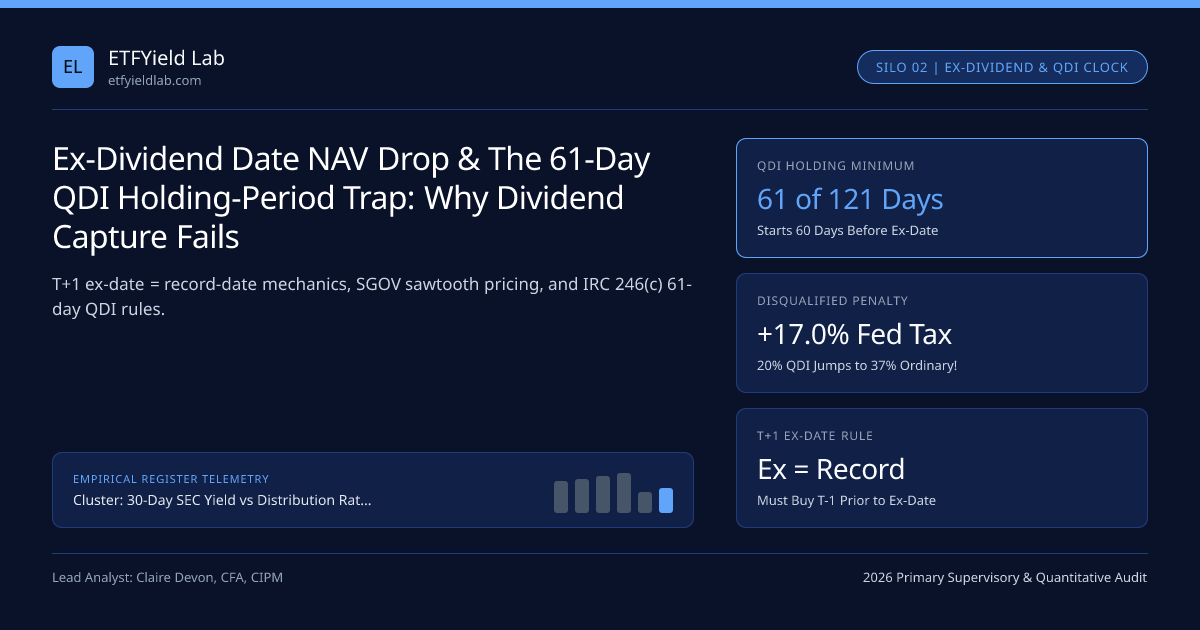
At 09:30 ET on an ETF ex-dividend date, exchange share prices and official NAV drop dollar-for-dollar by the declared distribution—turning naive pre-ex-date "dividend capture" trades into an immediate ordinary-tax liability when sold inside the 61-day IRC Section 1(h)(11) window.
Every quarter, retail forums rediscover the oldest mirage in finance: "Dividend Capture"—buying an equity or bond exchange traded fund on the afternoon before its ex-dividend date, pocketing the quarterly payout, and selling the shares a week later. Under exchange microstructure enforced by FINRA Rule 5330 and tax accounting governed by IRC Section 1(h)(11) and Section 246(c), pre-ex-date dividend capture produces zero pre-tax profit and a guaranteed after-tax loss! Even long-term taxable allocators routinely waste 15 to 45 bps of Day-1 capital by deploying lump sums into year-end distributions one day too early.
Inside our 30-Day SEC Yield & Tax Drag Hub and 30-Day SEC Yield vs Distribution Rate Guide, mastering T+1 Ex-Date Sawtooth Pricing and the 61-Day QDI Clock pairs directly with IRC Section 1091 wash-sale tax-loss harvesting and trailing 12-month vs forward distribution yields.
T+1 Ex-Date Alignment & The SGOV Monthly Sawtooth Proof#
Watch the daily price chart of iShares 0-3 Month Treasury Bond ETF (SGOV) across any 12-month window: it traces a perfect monthly sawtooth wave rising ~36 cents per share from day 1 to day 30, then dropping ~36 cents at 09:30 ET on the Ex-Dividend Date (which, since the May 2024 T+1 conversion, falls on the exact same calendar day as the Record Date!).
Mathematical Proof of "Buying the Dividend" Tax Destruction#
Suppose a top-bracket investor (37% Ord / 20% LTCG + 3.8% NIIT) invests $500,000 into a high-dividend or corporate bond ETF (Investment-Grade Corporate Bond ETFs or High-Yield Corporate Bond ETFs) declaring a $1.25/share ($1.25%) quarterly/special distribution tomorrow morning:
- Pre-Ex Purchase (T-1 @ $100.00):
- Receives $6,250 Taxable Cash Dividend + Holds $493,750 ETF Shares (Basis = $500,000)
- Immediate April IRS Tax Due = $6,250 * t_Div
- > If Ordinary Bond Div (40.8%): Pays $2,550 immediate tax out of own principal! (-51.0 bps!)
- > If Qualified Equity Div (23.8%): Pays $1,488 immediate tax! (-29.8 bps!)
- Post-Ex Purchase (T=0 Open @ $98.75, Assuming Zero Overnight Market Move):
- Receives $0.00 Taxable Dividend + Holds Full $500,000 Working Inside ETF (Basis = $500,000)
- Immediate April IRS Tax Due = $0.00! (+$1,488 to +$2,550 stays compounding for 15 years!)
- Failed "Dividend Capture" Flip (Buy T-1 @ $100, Sell T+5 @ $98.75 with Zero Long-Term Gains):
- Dividend Taxed @ 40.8% Non-QDI ($2,550 tax) vs $6,250 Short-Term Capital Loss
- If investor only has Long-Term Capital Gains (23.8%) to offset:
- Net Tax Loss on $0 Economic Trade = $6,250 * (40.8% - 23.8%) = -$1,062.50 Pure IRS Donation!
Look at that second proof: even if you use the $6,250 capital loss to offset $6,250 of 23.8% long-term capital gains elsewhere in your portfolio, failing the 61-day QDI rule turns a 23.8% dividend into a 40.8% non-qualified ordinary dividend, losing 17.0% of the entire dividend to a tax-rate mismatch—plus two round-trip bid-ask spreads! Model clean long-horizon DRIP compounding instead in our Dividend reinvestment calculator.
Holding-Period & Tax Rate Outcomes Across Trade Horizons#
SmartNuance: Why SGOV Is Different From Quarterly Equity ETFs!#
Wait—does "wait until ex-dividend date" mean you should leave cash sitting at 0.01% in a bank account for 25 days waiting for SGOV to go ex-dividend? NO if your alternative is zero-yield cash, because SGOV rises by ~1.2 bps/day every day you wait! However, if your cash is already earning 4.25% in a Treasury money market fund (FDLXX) and you plan to swap $500,000 into SGOV on November 29 (two days before SGOV goes ex-dividend on December 1), waiting 48 hours until December 1 morning avoids converting 28 days of November accrual into immediate taxable dividend while earning full money-market interest during the 48-hour wait!
| Purchase Scenario | Optimal Execution Timing | Custodian Tax-Lot Impact | Verification Tool |
|---|---|---|---|
$250k+ Equity ETF Lump Sum (SCHD / VOO / VXUS) | Wait 1-5 days if quarterly/Dec ex-date is imminent | Preserves 100% starting basis at Fidelity / Schwab | Sponsor Distribution Calendar |
| Cash -> SGOV from 0% Checking | Buy Immediately (daily yield accrual = ex-drop) | Check SALT % in T-Bill tax comparator | SIPC protected account |
| MMF -> Bond ETF (LQD) Swap | Execute ON Ex-Dividend Date (10:15 ET) | Avoids buying 30 days of 40.8%-taxed ordinary interest | ETF expense ratio calculator |
| Covered-Call Overlay on Own ETF | Sell OTM calls (>=30d, qualified covered call) | Deep ITM calls toll the 61-day QDI clock at IB / SEC! | IRS Pub 550 QCC Tables |
December Tax-Hygiene Calendar Rule#
Mark December 10 through December 30 in red on every taxable client's calendar: never invest new taxable cash lump sums into equity, bond, or international ETFs during the third week of December without first checking the fund's Ex-Dividend & Capital Gain Distribution Schedule!
Frequently asked questions
Under T+1 settlement, is the ETF ex-dividend date still one day before the record date?
No! Following the May 28, 2024 U.S. transition to T+1 settlement, FINRA Rule 11140 and NYSE/Nasdaq rules aligned the regular-way Ex-Dividend Date with the Record Date (Ex-Date = Record Date!). To receive an ETF dividend, you must purchase shares at least one trading day BEFORE the ex-dividend/record date.
Why do T-Bill ETFs like SGOV display a clean "sawtooth" share price chart every month?
SGOV accrues ~$0.35 to $0.42 of daily Treasury bill discount income inside its NAV across each month (rising smoothly from $100.05 to $100.42), then drops mechanically back to $100.05 on the first trading day of the new month when it goes ex-dividend.
How does the 61-day holding period rule work for Qualified Dividends on Form 1099-DIV Box 1b?
Both the ETF (holding the underlying stock) AND you (holding the ETF share) must hold the security for at least 61 days during the 121-day period starting 60 days before the ex-dividend date. Selling within 60 days—or buying a protective put option that tolls your holding clock—disqualifies QDI!
Should taxable investors buy a large equity or bond ETF lump sum right before or right after ex-dividend?
Wait until the Ex-Dividend Date morning! Buying on or just after the ex-dividend date acquires shares at the lower post-drop NAV, avoiding converting a slice of your fresh capital into an unnecessary current-year Form 1099-DIV tax bill.
Publication record
- Published
- November 13, 2026
- Updated
- November 14, 2026
- Author
- Claire Devon, CFA, CIPM
- Review
- Review not recorded
- Automated fact check
- Passed in the stored pipeline record
- Source URLs
- 4 recorded
AI assistance recorded: anthropic/claude-opus-4.6. This field does not establish human review or source verification.
Academic & Institutional Attribution
Cite This Research & Embed Live Data Card
Standard academic & institutional research paper citation format.
Claire Devon, CFA, CIPM. (2026, November 14). Ex-Dividend Date NAV Drop & The 61-Day QDI Holding-Period Trap: Why Dividend Capture Fails. ETFYield Lab. https://etfyieldlab.com/yield-guides/ex-dividend-date-nav-drop-61-day-qdi-holding-period-trapRegulatory Directory Cross-Reference
Referenced Institutions & Regulatory Registries
Mentioned Regulated Institutions
Related SEC Yield Distribution Tax Drag & Institutional Briefings
Explore SEC Yield Distribution Tax Drag Hub (20) →SEC Yield Distribution Tax Drag
30-Day SEC Yield vs Distribution Rate, Return of Capital & After-Tax ETF Yield Drag GuideSEC Yield Distribution Tax Drag
IRC Section 1091 Wash-Sale Rules & "Substantially Identical" Bond ETF Tax-Loss Harvesting SwapsSEC Yield Distribution Tax Drag
Contractual vs Voluntary ETF Expense Ratio Fee Waivers: Auditing Subsidized SEC Yield CliffsSEC Yield Distribution Tax Drag
Acquired Fund Fees and Expenses (AFFE) in BDC, CEF & Multi-Asset ETFs: SEC Item 3 Optical RulesSEC Yield Distribution Tax Drag
UK HMRC Offshore Reporting Fund Status & Excess Reportable Income (ERI) on Accumulating UCITS ETFsSEC Yield Distribution Tax Drag
Foreign Tax Credit Pass-Through (IRC Section 853 & Form 1116) in International Dividend & Bond ETFsSEC Yield Distribution Tax Drag
IRC Section 1276 Market Discount Bond Rules: Hidden Ordinary-Income Tax Traps in Discounted Bond ETFsSEC Yield Distribution Tax Drag
IRC Section 199A 20% REIT Dividend Deduction Pass-Through in Real Estate & Dividend ETFsTreasury Bill Bond Ladder Etfs
Zero-Coupon Treasury STRIPS ETFs (EDV & ZROZ) vs 20+ Year Coupon TLT: 25-Year Duration & Convexity MathTreasury Bill Bond Ladder Etfs
Core Aggregate Bond ETFs (AGG & BND) vs Pure Treasury (GOVT): Agency MBS Convexity & Issuance DriftTreasury Bill Bond Ladder Etfs
Agency CMBS ETFs (CMBS) vs Residential Mortgage-Backed ETFs (MBB & VMBS): Lockout Call Protection & OAS MathTreasury Bill Bond Ladder Etfs
Ultrashort Active Corporate & Commercial Paper ETFs (JPST, MINT & ICSH) vs Pure T-Bill ETFs: SALT Tax Audit
ETFYield Lab Data, Benchmarks & Contributor Records
CC BY 4.0 Open Data
Open Institutional Datasets (CSV / JSON) →
Download desk-compiled quantitative series & schemas.
2026 Reference Matrix
2026 Institutional Benchmarks & Thresholds →
Statutory capital, clearing, margin & rate conventions.
Editorial Records
Authors & Review Records →
View named contributors where those records are available.
Complete Index
Master Research & Dossier Archive →
Browse all published briefings by topic pillar & date.